
CUHK and Charles K. Kao Foundation expand BEAT AD dementia prevention programme to community following encouraging pilot results
The Chinese University of Hong Kong (CUHK)’s Faculty of Medicine (CU Medicine) and the Charles K. Kao Foundation for Alzheimer’s Disease (Charles K. Kao Foundation) announced positive outcome of the pilot phase of their collaborative Brain Health Evaluation And Tailor-made Measures for Prevention of Alzheimer’s Disease Programme (BEAT AD), identifying one-fifth of participants who are at increased risk of dementia with artificial intelligence (AI)-powered retinal imaging technology and provided them with tailor-made recommendations for brain health. Notably, participants receiving personalised brain health management also demonstrated improvements in cognitive performance, with their cognitive scores approaching levels typically observed in individuals approximately three years younger.
Based on the success of the pilot BEAT AD Programme, the team is going to expand the initiative into the community in partnership with the Hong Kong Sheng Kung Hui Welfare Council (SKHWC). The new BEAT AD at Wong Tai Sin (BEAT AD@WTS) Programme will be launched in January 2027, combining advanced medical technology with community-based social prescribing to provide free brain health evaluations and structured preventive support to 2,700 older adults over a two-year period.
.jpg)
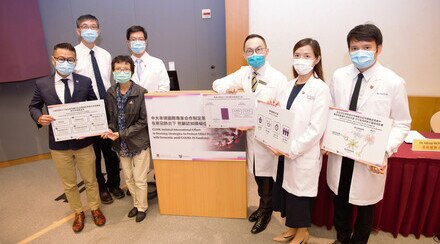
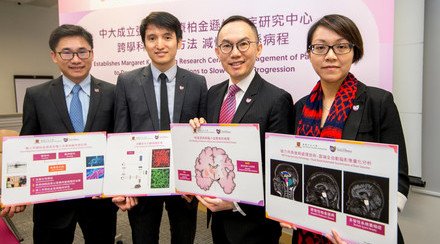
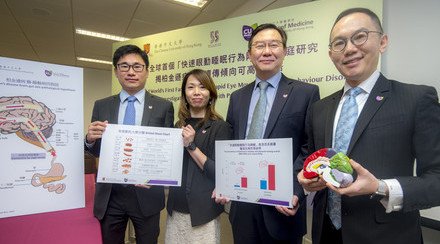
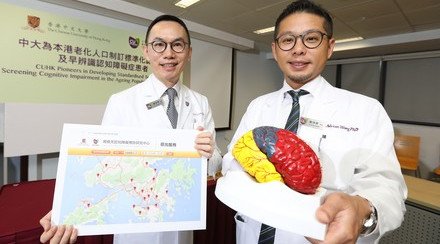
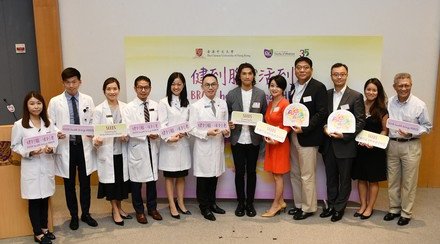
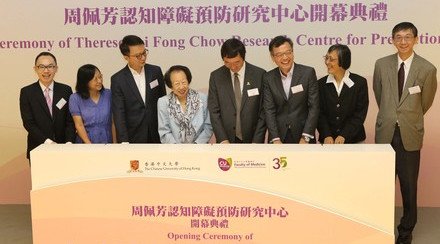
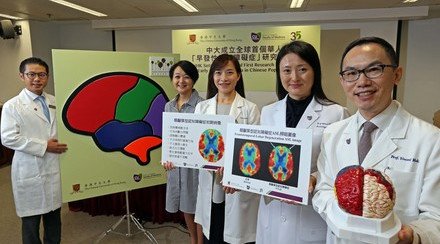
CU Medicine and the Charles K. Kao Foundation announce positive outcomes from the pilot phase of their collaborative BEAT AD Programme. Building on this success, the team is going to expand the initiative into the community in partnership with the Hong Kong Sheng Kung Hui Welfare Council (SKHWC). (From left) Professor Vincent Mok Chung-tong, Co-Director of the Programme and Mok Hing Yiu Professor of Medicine, CUHK; Ms Lam, BEAT AD pilot programme participant; Dr William Lo Wing-yan, Chairman of the Charles K. Kao Foundation; Dr Chiu Ha-ying, Governor and Executive Committee Member of the Charles K. Kao Foundation and Co-Director of the Programme; and Ms Esther Wong, Assistant Director of the SKHWC.
Dementia prevention through modifiable risk factors
In Hong Kong, the number of people living with dementia is projected to rise from approximately 180,000 in 2026 to 240,000 by 20361,2. Alzheimer’s disease is the most common cause of dementia, accounting for approximately 70% of cases. In response to the growing burden of dementia, the Charles K. Kao Foundation partnered with CU Medicine’s Neurology team to launch the BEAT AD Programme in October 2023.

14 potentially modifiable risk factors

Dr William Lo, Chairman of the Charles K. Kao Foundation
International evidence suggests that addressing 14 potentially modifiable risk factors, including physical inactivity, hypertension, diabetes, social isolation and depression, could prevent or delay nearly half of all dementia cases. The BEAT AD Programme identifies cognitively normal older adults who may be at increased risk of dementia and provides tailor-made recommendations to help reduce their risk.
Dr William Lo Wing-yan, Chairman of the Charles K. Kao Foundation, said, “Professor Kao lived with Alzheimer’s disease in his later years. Together with Mrs Gwen Kao, who cared for him throughout his illness, he co-founded this Foundation so that others might face a different future. Having already served more than 1,500 older adults, the early results of BEAT AD show that dementia prevention is possible. Bringing this scientific breakthrough out of the university and into the community is the next step. We are deeply grateful to Mrs Kao for her vision and continuous inspiration; to Dr Brigitte Lin Ching-hsia, Patron and Ambassador of the BEAT AD Programme, whose generous donation made the original pilot possible; and to all our other donors.”
AI-powered retinal imaging identifies poorer brain health and supports targeted intervention
A distinctive feature of the BEAT AD Programme is the use of AI-powered retinal imaging technology developed by CUHK researchers. By analysing retinal photographs, the technology assists in identifying cognitively normal individuals who may nevertheless be at an increased risk of developing Alzheimer’s disease.
Among 831 cognitively normal community participants, approximately 21% screened positive using the AI-powered technology. These individuals demonstrated poorer cognitive performance and control of modifiable dementia risk factors. One-year follow-up data involving 532 participants showed greater improvement in Brain Health Score among those receiving personalised brain health management (an increase of 1.3 points) than those receiving brain health education alone (an increase of 0.2 points). Participants receiving personalised brain health management also demonstrated improvements in cognitive performance, with their cognitive scores approaching levels typically observed in individuals approximately three years younger.

Ms Lam, a 74-year-old participant of the BEAT AD pilot programme who underwent screening and assessment three years ago, originally scored 6 out of 12 on a cognitive test. By improving her lifestyle – incorporating more physical exercise and engaging in social activities – her score rises to 11 a year later, and she now reports a noticeable improvement in her memory.

Professor Vincent Mok, Co-Director of the Programme and Mok Hing Yiu Professor of Medicine, CUHK
Professor Vincent Mok Chung-tong, Co-Director of the Programme and Mok Hing Yiu Professor of Medicine, CUHK, remarked, “Our AI-powered retinal imaging technology enables us to identify older adults with suboptimal brain health before dementia develops. One year of personalised brain health management was associated with better control of modifiable dementia risk factors and improvements in cognitive performance. These findings highlight the potential of integrating AI-assisted screening with targeted preventive care.” The research findings were presented at the Alzheimer’s Association International Conference 2026 in London in July.
From university-based pilot programme to community dementia prevention

Dr Chiu Ha-ying, Governor and Executive Committee Member of the Charles K. Kao Foundation and Co-Director of the Programme
Dr Chiu Ha-ying, Governor and Executive Committee Member of the Charles K. Kao Foundation and Co-Director of the Programme, said, “The encouraging results from our pilot programme at the CUHK provide a strong basis for bringing the BEAT AD service to older adults in the community. Wong Tai Sin District has one of the highest proportions of older residents in Hong Kong and consequently bears a high dementia burden, resulting in our decision to bring accessible dementia prevention and brain health services to this particular district, as the programme’s first step into the wider community. The programme will be implemented through two SKHWC elderly centres with established community networks in Wong Tai Sin. Through this initiative, we hope to demonstrate how evidence-based dementia risk reduction can be effectively integrated into community elderly services.”
As the strategic community service partner, SKHWC will integrate the programme into its existing elderly service network, leveraging its extensive experience in active ageing, dementia care, and community support to help older adults sustain healthy lifestyle changes.

Ms Esther Wong, Assistant Director of the SKHWC
Ms Esther Wong, Assistant Director of the SKHWC, concluded: “The BEAT AD@WTS Programme provides an invaluable opportunity to bridge medical innovation with frontline community care. By incorporating social prescribing approaches, our teams will connect participants with tailored physical, cognitive, social, and volunteer activities directly within the Wong Tai Sin community. We hope to demonstrate how proactive, community-based prevention can help older adults maintain their brain health before cognitive symptoms emerge, empowering them to sustain positive lifestyle changes for the long term.”
4 November marks the birth anniversary of the late Professor Sir Charles K. Kao, Nobel Laureate in Physics and former vice-chancellor of CUHK, who lived with Alzheimer’s disease in his later years. Through this initiative, the team aims to raise public awareness of Alzheimer’s disease and its associated risk factors, and encourage greater attention to dementia prevention and brain health. Public registration for the programme will open in January 2027 via the official registration link.
[1] Lam, L. C., Chan, W., Lee, A. T., Huo, Z., Lin, V. C., Fung, A. W., Ma, S., Cheng, C. P., Cheng, S., Lai, F. H., Yip, B. H., & Wong, S. Y. (2026). Prevalence of mild and major neurocognitive disorders in community and residential care homes in Hong Kong: Considerations for multidimensional risk factor evaluation and intervention in Primary Care. Hong Kong Medical Journal. https://doi.org/10.12809/hkmj2412656
[2] Census and Statistics Department. Hong Kong Monthly Digest of Statistics, October 2023