
Search
What are you looking for?
Start main content

Press Releases

Press Releases

https://www.med.cuhk.edu.hk/press-releases/cuhk-study-reveals-how-the-brain-controls-muscles-for-voluntary-movement-offering-transformative-insights-for-brain-machine-interface-and-precision-neurosurgery

CUHK study uncovers how the brain coordinates muscles for voluntary movement, setting new benchmark for precision neurosurgery and opening breakthrough avenues for brain-machine technology and paralysis rehabilitation

A new study by the Faculty of Medicine at The Chinese University of Hong Kong (CU Medicine) has revealed how the human brain controls muscles for voluntary movement. By studying patients undergoing awake brain surgery, researchers discovered that the brain organises individual muscles into functional “building blocks” (muscle synergies) to coordinate multiple muscle groups simultaneously.  


The findings resolve a long-standing debate in neuroscience while offering transformative insights for the future design of brain-machine interfaces (BMI), setting a new benchmark for precision neurosurgery. The study has been published in the prestigious international scientific journal Proceedings of the National Academy of Sciences (PNAS).  


Brain bundles muscles into building blocks to control movement 


Even simple daily actions, such as walking or picking up a cup, require the brain to control and coordinate multiple muscle groups concurrently. For decades, neuroscientists have debated how the central nervous system directs highly complex muscle operations: whether it controls each muscle individually or commands them through combined units known as “muscle synergies”. 


To decode this mechanism, the CUHK research team, comprising neuroscientists and neurosurgeons, studied the muscle signals of 13 patients undergoing awake craniotomy surgery for glioma tumour removal. During awake brain surgery, patients remained conscious while neurosurgeons applied mild direct electrical stimulation to the primary motor cortex (M1), the brain region that controls voluntary movement. Researchers collected and analysed real-time electromyographic (EMG) data on muscle responses while patients performed voluntary upper-limb tasks before and during surgery. 


Dr Jodie Xie

Dr Jodie Xie Jingping

Results showed that 69% of the muscle synergies observed during preoperative voluntary movements could be matched to muscle synergies evoked by direct electrical stimulation during surgery. Furthermore, neuroimaging analysis revealed that the human motor cortex contains two subdivisions, each with a distinct pattern of muscle group organisation. 


Dr Jodie Xie Jingping, the study’s first author and Postdoctoral Fellow in the School of Biomedical Sciences at CU Medicine, said: “This study confirmed M1 controls the activities of multiple muscles by activating fundamental building blocks of movement known as ‘muscle synergies’.”  

Implications for brain-machine interfaces and motor rehabilitative interventions 


Professor Vincent Cheung

Professor Vincent Cheung 

Professor Vincent Cheung Chi-kwan, Associate Professor in the School of Biomedical Sciences at CU Medicine, explained: “Brain-machine interfaces (BMIs) is an emerging medical technology where  electrodes are implanted into the motor cortex of paralysed patients. By recording the neural signals generated when patients consciously attempt to move their limbs, the system decodes and translates these signals to drive assistive devices that help them communicate or regain mobility. Since M1 is a primary implantation site of BMIs for movement control, our findings will help inform the design of more precise and effective BMI systems, providing an important scientific basis for electrode placement strategies. The findings also offer valuable insights for designing and improving future motor rehabilitative interventions.”  

Real-time muscle mapping for safer brain surgery 


Dr Peter Woo

Dr Peter Woo

The team exploited direct electrical stimulation of the human brain to monitor and record activities of multiple muscles in real-time. Before removing a brain tumour during an awake surgery, a neurosurgeon stimulates the patient’s brain to map critical movement areas. If stimulating a specific spot triggers a muscle reaction, the surgeon knows that area must be preserved to prevent post-operative paralysis.  


Dr Peter Woo Yat-ming, Honorary Clinical Associate Professor in the Department of Surgery at CU Medicine, said: “This procedure enables neurosurgeons to map the brain even more precisely, minimising any undesired functional impairment after surgery. By understanding the true functional substrates of the motor cortex, we can build stronger bridges between fundamental neuroscience and patient care.” 

Professor Cheung concluded, “With this study, we hope to demonstrate how neurosurgeons and neuroscientists can work together to solve fundamental open questions about the human brain whose solutions should ultimately benefit patients.” 


This study was supported by the General Research Fund (GRF) under the Research Grants Council of the University Grants Committee.  
More Press Releases

CUHK Introduces High Frequency Oscillations to Determine Resection Margin Increases the Effectiveness of Complex Epilepsy Surgery by around 30%

CUHK Introduces High Frequency Oscillations to Determine Resection Margin Increases the Effectiveness of Complex Epilepsy Surgery by around 30%

Surgical advancement
CUHK Pioneers Surgical Treatment of Deep Brain Stimulation for Tardive Dystonia in HK

CUHK Pioneers Surgical Treatment of Deep Brain Stimulation for Tardive Dystonia in HK

Surgical advancement
CUHK finds methadone far more effective than morphine for post-cardiac surgery pain relief: with 60% less acute pain and 70% lower opioid dependence

CUHK finds methadone far more effective than morphine for post-cardiac surgery pain relief: with 60% less acute pain and 70% lower opioid dependence

Research
CUHK pioneers to introduce multimodality focal therapy for prostate cancer in Hong Kong   slashing surgical and hospitalisation time and reducing trauma and complications

CUHK pioneers to introduce multimodality focal therapy for prostate cancer in Hong Kong slashing surgical and hospitalisation time and reducing trauma and complications

Surgical advancement
CUHK successfully conducts intercontinental telesurgery with self-developed surgical robotics across 20,000 km in three cities

CUHK successfully conducts intercontinental telesurgery with self-developed surgical robotics across 20,000 km in three cities

Surgical advancement
CU Medicine establishes Asia’s first bladder cancer organoid biobank Pioneering a new era in precision medicine with a “test-before-treatment” approach

CU Medicine establishes Asia’s first bladder cancer organoid biobank Pioneering a new era in precision medicine with a “test-before-treatment” approach

Research
CUHK and HKU jointly develop a potential new treatment for brain tumours and Parkinson’s disease

CUHK and HKU jointly develop a potential new treatment for brain tumours and Parkinson’s disease

Research
CU Medicine and Olympus Corporation sign MoU to develop  innovative endoscopy and laparoscopy technologies

CU Medicine and Olympus Corporation sign MoU to develop innovative endoscopy and laparoscopy technologies

Surgical advancement
CU Medicine proves a new ultrasound-guided endoscopic procedure has higher success and shorter procedural time for treating malignant distal biliary obstruction

CU Medicine proves a new ultrasound-guided endoscopic procedure has higher success and shorter procedural time for treating malignant distal biliary obstruction

Research
CU Medicine first in Asia to perform one-stage hybrid aortic arch surgery on patients with multi-segment thoracic aortic diseases using novel device

CU Medicine first in Asia to perform one-stage hybrid aortic arch surgery on patients with multi-segment thoracic aortic diseases using novel device

Research
Study led by CUHK shows robotic-assisted bladder removal with intracorporeal urinary diversion reduces blood loss and enhances post-operative recovery

Study led by CUHK shows robotic-assisted bladder removal with intracorporeal urinary diversion reduces blood loss and enhances post-operative recovery

Research
CU Medicine and International Surgeons Suggest Patients with Positive COVID-19 Results Should Delay Surgery for Seven Weeks to Reduce Death Risk

CU Medicine and International Surgeons Suggest Patients with Positive COVID-19 Results Should Delay Surgery for Seven Weeks to Reduce Death Risk

International collaboration
CUHK and HKBU Launch Spermine Risk Score for Prostate Cancer Diagnosis

CUHK and HKBU Launch Spermine Risk Score for Prostate Cancer Diagnosis

Research
CUHK Identifies Outcome Indicators for Benign Prostatic Hyperplasia Patients Receiving Prostatic Artery Embolisation

CUHK Identifies Outcome Indicators for Benign Prostatic Hyperplasia Patients Receiving Prostatic Artery Embolisation

Research
CU Medicine Studies Highlight Smoking as a Contributing Factor for Bladder Cancer and  Develop an International Collaborative Consensus on En Bloc Resection to Treat the Disease

CU Medicine Studies Highlight Smoking as a Contributing Factor for Bladder Cancer and Develop an International Collaborative Consensus on En Bloc Resection to Treat the Disease

Research
CUHK Successfully Performed World’s First Colorectal Endoscopic Submucosal Dissection  Using Flexible Endoscopic Robotic System

CUHK Successfully Performed World’s First Colorectal Endoscopic Submucosal Dissection Using Flexible Endoscopic Robotic System

Surgical advancement
A Joint Study by CUHK, PolyU and Western Sydney University Discovers how the Nervous System of Human Runners Generates More Energetically Efficient Running Forms

A Joint Study by CUHK, PolyU and Western Sydney University Discovers how the Nervous System of Human Runners Generates More Energetically Efficient Running Forms

Research
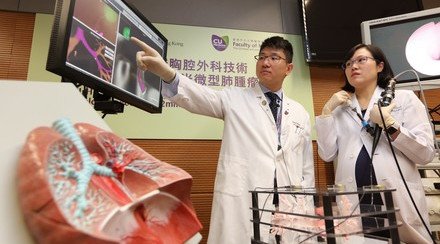
CUHK Successfully Conducts Asia-Pacific’s First Hybrid Operating Room Non-invasive Bronchoscopic Microwave Ablation to Treat Lung Cancer

CUHK Successfully Conducts Asia-Pacific’s First Hybrid Operating Room Non-invasive Bronchoscopic Microwave Ablation to Treat Lung Cancer

Surgical advancement
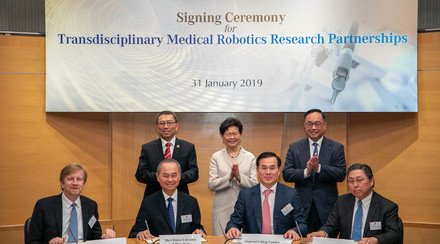
CUHK Deepening Ties with World Leading Institutes for Transdisciplinary Medical Robotics Research to Reshape the Future of Diagnosis and Treatment

CUHK Deepening Ties with World Leading Institutes for Transdisciplinary Medical Robotics Research to Reshape the Future of Diagnosis and Treatment

International collaboration
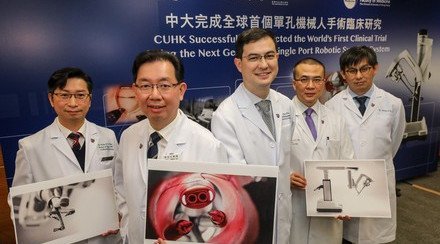
CUHK Successfully Conducted the World’s First Multi-Specialty Clinical Trial Using the Next Generation Single Port Robotic Surgical System

CUHK Successfully Conducted the World’s First Multi-Specialty Clinical Trial Using the Next Generation Single Port Robotic Surgical System

Surgical advancement
CUHK Pioneers Early Lung Cancer Treatment with Hybrid Operating Room Image Guided Electromagnetic Navigation Bronchoscopy

CUHK Pioneers Early Lung Cancer Treatment with Hybrid Operating Room Image Guided Electromagnetic Navigation Bronchoscopy

Surgical advancement
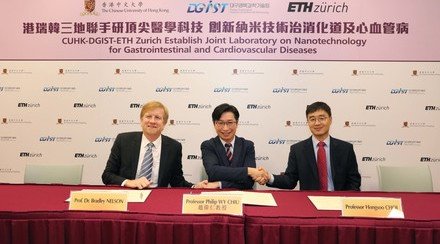
CUHK-DGIST-ETH Zurich Establish Joint Laboratory on Nano-technology for Gastrointestinal and Cardiovascular Diseases

CUHK-DGIST-ETH Zurich Establish Joint Laboratory on Nano-technology for Gastrointestinal and Cardiovascular Diseases

International collaboration
CUHK’s Gerald Choa Neuroscience Centre Unveils Mystery of How Brain Learns Motor Skills

CUHK’s Gerald Choa Neuroscience Centre Unveils Mystery of How Brain Learns Motor Skills

Research
CUHK Succeeds in Treating Gastroesophageal Reflux Disease by Implantable Pulse Generator

CUHK Succeeds in Treating Gastroesophageal Reflux Disease by Implantable Pulse Generator

Surgical advancement
Dr. Lui Che Woo Distinguished Professor Public Lecture by Prof. Steven C. Cramer on Brain Repair after Stroke

Dr. Lui Che Woo Distinguished Professor Public Lecture by Prof. Steven C. Cramer on Brain Repair after Stroke

Education
CUHK-PWH Hybrid Cardiovascular Operating Theatre Officially Opens Multi-functional Setting Enhances Surgical Outcomes

CUHK-PWH Hybrid Cardiovascular Operating Theatre Officially Opens Multi-functional Setting Enhances Surgical Outcomes

Clinical service
Bowel Cancer Will Become Top Cancer in Hong Kong CUHK Introduces Colon Pill Camera to Prevent Bowel Cancer

Bowel Cancer Will Become Top Cancer in Hong Kong CUHK Introduces Colon Pill Camera to Prevent Bowel Cancer

Surgical advancement
CUHK Proves a Non-invasive Technology Can Successfully Cure Cerebral Arteriovenous Malformation

CUHK Proves a Non-invasive Technology Can Successfully Cure Cerebral Arteriovenous Malformation

Clinical service

Our Expert List

Many experts under the Faculty of Medicine are available for media interview.
Please click here for the expert list or contact us.